

On this page
Year-end is when budgets get set, fee schedules get revisited, and lease templates get refreshed. That makes it the right time to find gaps before they're copied into another twelve months of listings and leases.
This checklist covers eleven items. Together, they give you a clear picture of what renters see, what you charge, and what you can show afterward.
Where things stand heading into 2027…
Federal: On March 13, 2026, the FTC published an advance notice of proposed rulemaking on rental housing fees. It asks whether a rule should require the total rent, including all mandatory fees, whenever a price is quoted, and whether that disclosure should come before application or holding fees are charged. Comments closed April 13, 2026. As of mid-October 2026, no proposed rule text has been published.
States are pushing for one. On April 13, 2026, a bipartisan coalition of 26 attorneys general, including the District of Columbia, urged the FTC to require clear disclosure of the total cost of rental housing in ads and listings.
Enforcement isn't waiting for a rule. In December 2025, Greystar agreed to pay $24 million ($23 million to the FTC and $1 million to Colorado) to settle allegations that it left mandatory fees out of advertised rent. The order requires Greystar to disclose each fee and the total monthly price before taking any payment, such as a nonrefundable application fee. Separately, Invitation Homes agreed to pay $48 million to settle FTC allegations that included leaving mandatory monthly fees out of advertised rent.
State and local. Some rules are already in effect. Colorado's HB25-1090 took effect January 1, 2026. It requires advertised pricing to disclose the total of all amounts that may be charged. If a landlord doesn't refund or stop charging an unlawful fee within 14 days of a renter's written demand, the landlord is liable for actual damages plus 18% annual interest. Seattle's rental fee rules take effect July 1, 2027.
For a side-by-side of how Massachusetts, Colorado, Illinois and Seattle differ, see our buyer's guide to leasing compliance platforms.
→ 1. Audit every listing for a true total price
Pull your active listings across your website and every ILS. Confirm the advertised price includes all mandatory recurring fees. The Greystar order, for example, requires the full monthly cost to be more prominent than base rent whenever partial pricing is advertised. Check syndicated listings closely; they often lag behind your source data.
See how Fee Transparency carries one total monthly price from the listing into the lease.
→ 2. Reconcile your fee schedule against what you actually charge
Compare your published fee schedule with a sample of resident ledgers. Any charge that shows up on a ledger but not on the schedule, or at a different amount than disclosed, goes on your fix list now.

→ 3. Classify every fee as mandatory or optional, and label it
The Greystar order requires disclosing whether each fee is mandatory, and the FTC's notice asks about optionality and refundability. Label every fee one way or the other. For optional fees, make it clear to renters how to decline them.
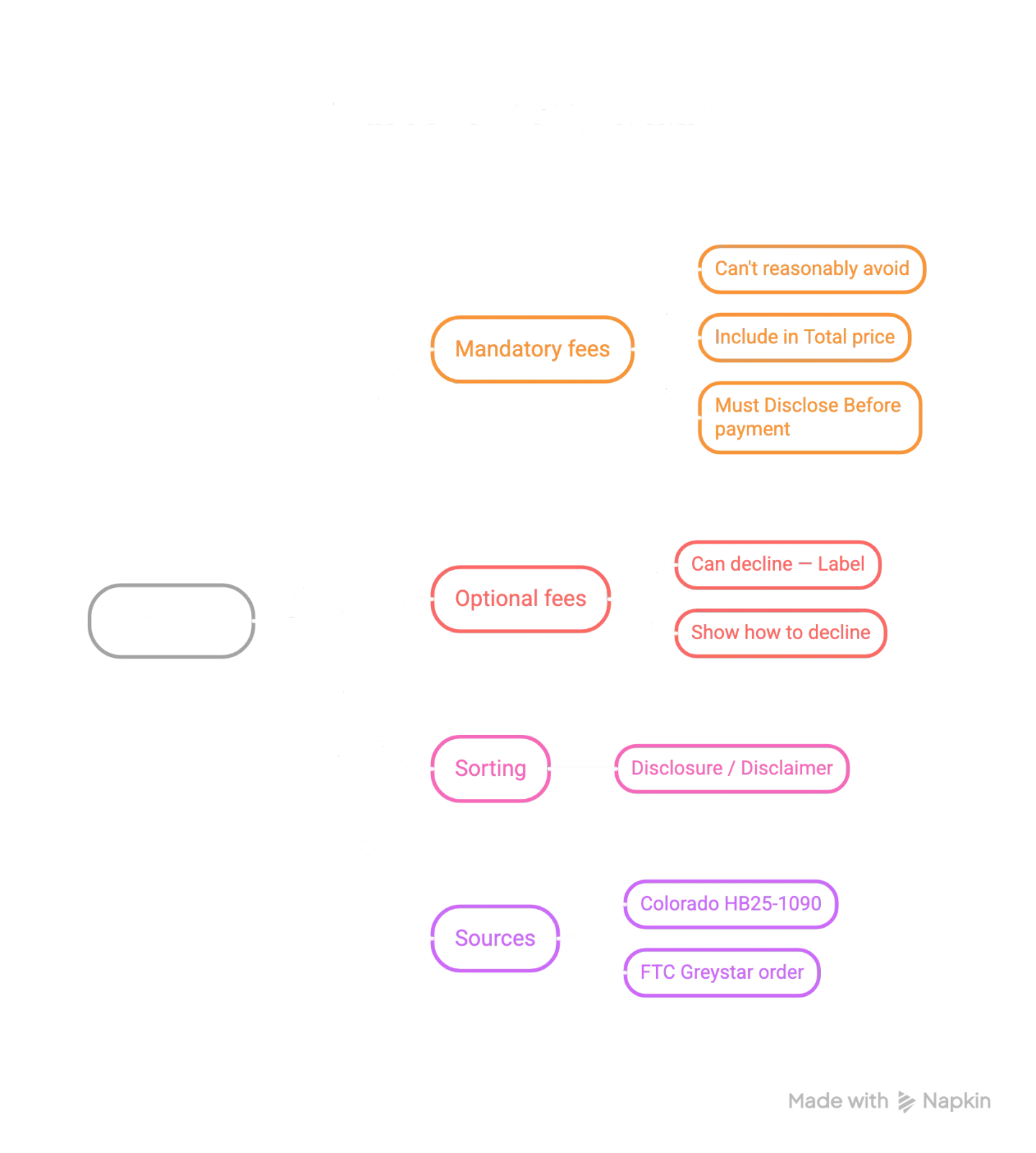
Sort first, then disclose. Sources: Colorado HB25-1090; FTC Greystar order.
→ 4. Check the timing of disclosures
Confirm renters see the full monthly cost before they pay any nonrefundable application fee or deposit. That timing appears in the Greystar order, and the FTC's notice asks whether a rule should require it.
→ 5. Review payment processing and convenience fees
Colorado's HB25-1090 restricts which fees a landlord may require a tenant to pay, and payment processing fees are among those it addresses. Confirm how the law treats them for your Colorado properties. Everywhere else, disclose any card or convenience surcharge before the renter confirms payment.
→ 6. Look at third-party pass-through fees and markups
Utility billing, trash, pest control and package services come up again and again in fee disputes. In Colorado, a landlord may require a markup on a service it's billed for of up to 2% of the billed amount or up to $10 per month, but not both. Know what you're marking up, and confirm the lease authorizes it.
→ 7. Refresh lease templates
Make sure fee itemization in the lease matches what was disclosed upfront. If you operate in Seattle, start planning now. For agreements entered into after July 1, 2027, the ordinance requires a disclosure form of no more than two pages before the first page of the rental agreement, showing rent, utilities, every mandatory and optional fee, and the total monthly cost.
→ 8. Confirm screening criteria are written, consistent and applied
Document your criteria by property. Confirm they're applied the same way to every applicant, and that adverse action notices go out on time with the required content.
Screening & Identity keeps configured criteria, screening results and decision history connected to each application.
→ 9. Test your audit trail
Pick three random leases from this year. For each one, can you show what the renter was shown, what they acknowledged and when? Pull five pieces of evidence per lease, in the order the renter moved through them:
- The price at first look: the total monthly price on the listing or quote the renter saw.
- The disclosure before payment: the fee details and total shown before the application fee, and the time each happened.
- The renter's acknowledgment: which fees they acknowledged, marked mandatory or optional, and when.
- The screening decision: the criteria applied, the decision, and any adverse action notice that went out.
- The signed lease: the fees itemized in the lease, compared with what was disclosed upfront.
If any of the fifteen takes more than a few minutes to produce, or doesn't match the step before it, add it to your January list.
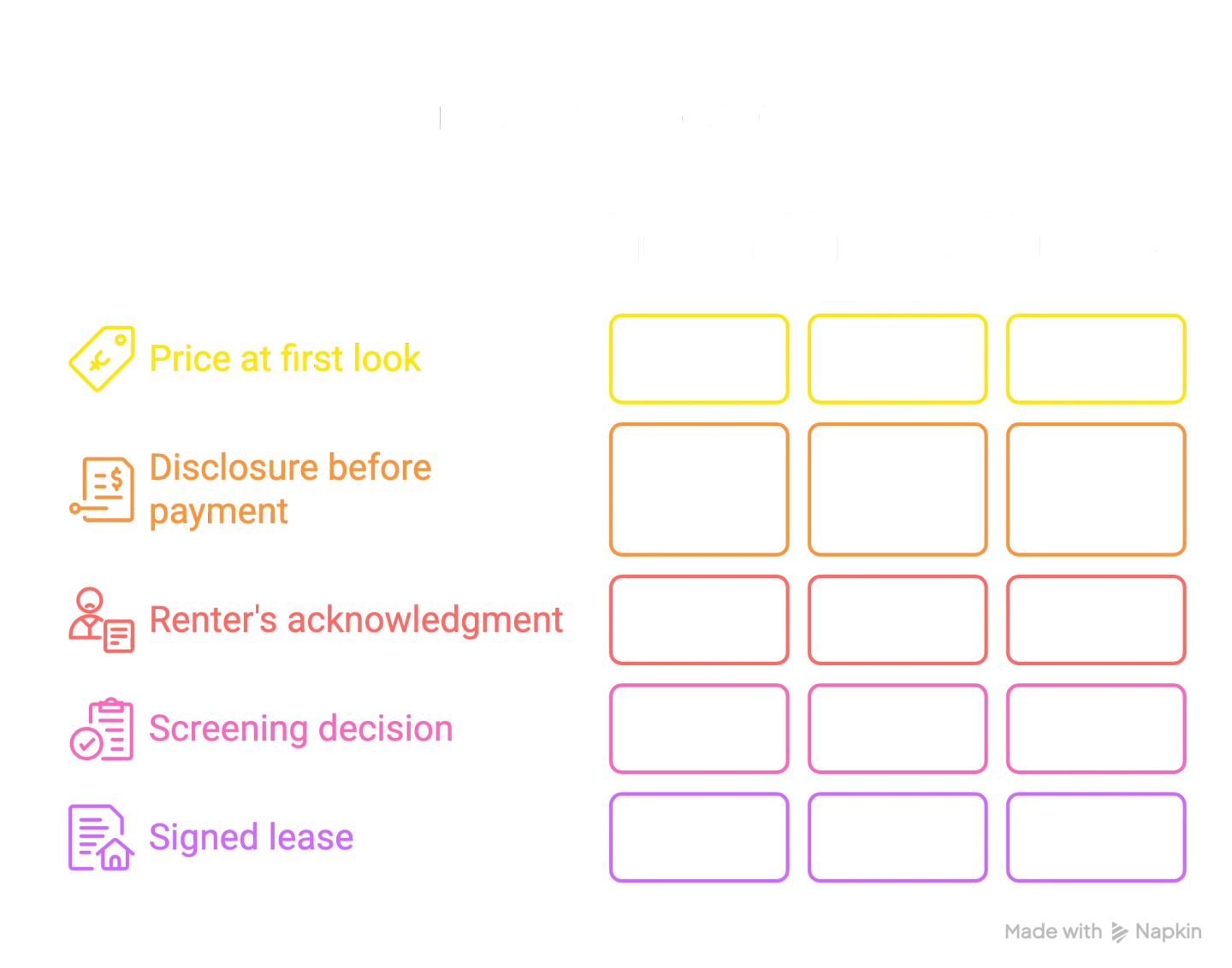
Five pieces of evidence, three leases, fifteen checks. Any "slow" or "not found" goes on your January list. Illustrative template; the pass criteria come from the Greystar order, the FCRA and the checks in this list.
See what a connected Audit Trail captures from application to signed lease package.
→ 10. Map your 2027 jurisdiction watchlist
List every state and city where you operate and note pending legislation. Cities are writing their own fee rules. Seattle's take effect July 1, 2027, so the next rule that affects your portfolio may come from a city council, not a statehouse.
NOVY's Regulatory Tracking is a curated cross-reference of state and local rules, reviewed and dated by the NOVY team.
→ 11. Retrain leasing teams
Rules only work when the people applying them understand them. Build a short refresher on fee disclosure and screening consistency into January onboarding and team meetings.
One workflow, all year
None of these items is complicated on its own. The hard part is that each one usually lives in a different place: listings in one system, fees in another, leases and screening decisions somewhere else. That's why the same checks come back every December.
NOVY carries configured charges, disclosures, screening decisions and the renter's acknowledgments through one governed leasing workflow, from the listing to the signed lease package. What the renter sees carries through to what they sign, and next year's review starts from what's already documented.
*This checklist is general information, not legal advice. Confirm your specific obligations with counsel in each jurisdiction where you operate.